The basis for testing in conventional software development is a simple algorithm that takes an input, calculates a state, and outputs a result. Therefore, a test that fails indicates the presence of a bug in the program logic.
However, these standard testing practices are unsuitable for quantum software because, at the quantum level, calculations exist in a range of states, algorithms have probabilistic results, and computation is performed on physically fragile hardware.
1. The Core Paradoxes of Quantum QA
Software Engineers who enter the quantum domain face four fundamental physical limitations right away: The Measurement Dilemma (Wave Function Collapse): You can’t place a classical breakpoint or print an intermediate variable in a quantum circuit. When you measure the qubit it collapses its wave function $\vert{}0\rangle$ or $\vert{}1\rangle$ and you destroy the quantum coherence required to continue the computation.The No-Cloning Theorem: Classical testers duplicate states, make snapshots and run their asserts in parallel. Quantum mechanics forbids making an identical copy of an arbitrary unknown quantum state rendering classical state-caching and rollback strategies invalid. The Probabilistic Assertions: Quantum algorithms rarely give you a single answer, they spit out a distribution of answers. Testing is really an exercise in statistical hypothesis testing and asserting your actual != expected some fraction of the time. Hardware Noise & Decoherence: In the current era of quantum processors, errors are not really due to buggy code running on the processor. Thermal fluctuations, crosstalk, and gate infidelities dominate, introducing an environmental noise that has to be statistically deconvolved from algorithmic errors.
2. Classical versus Quantum Testing: A Comparison Table
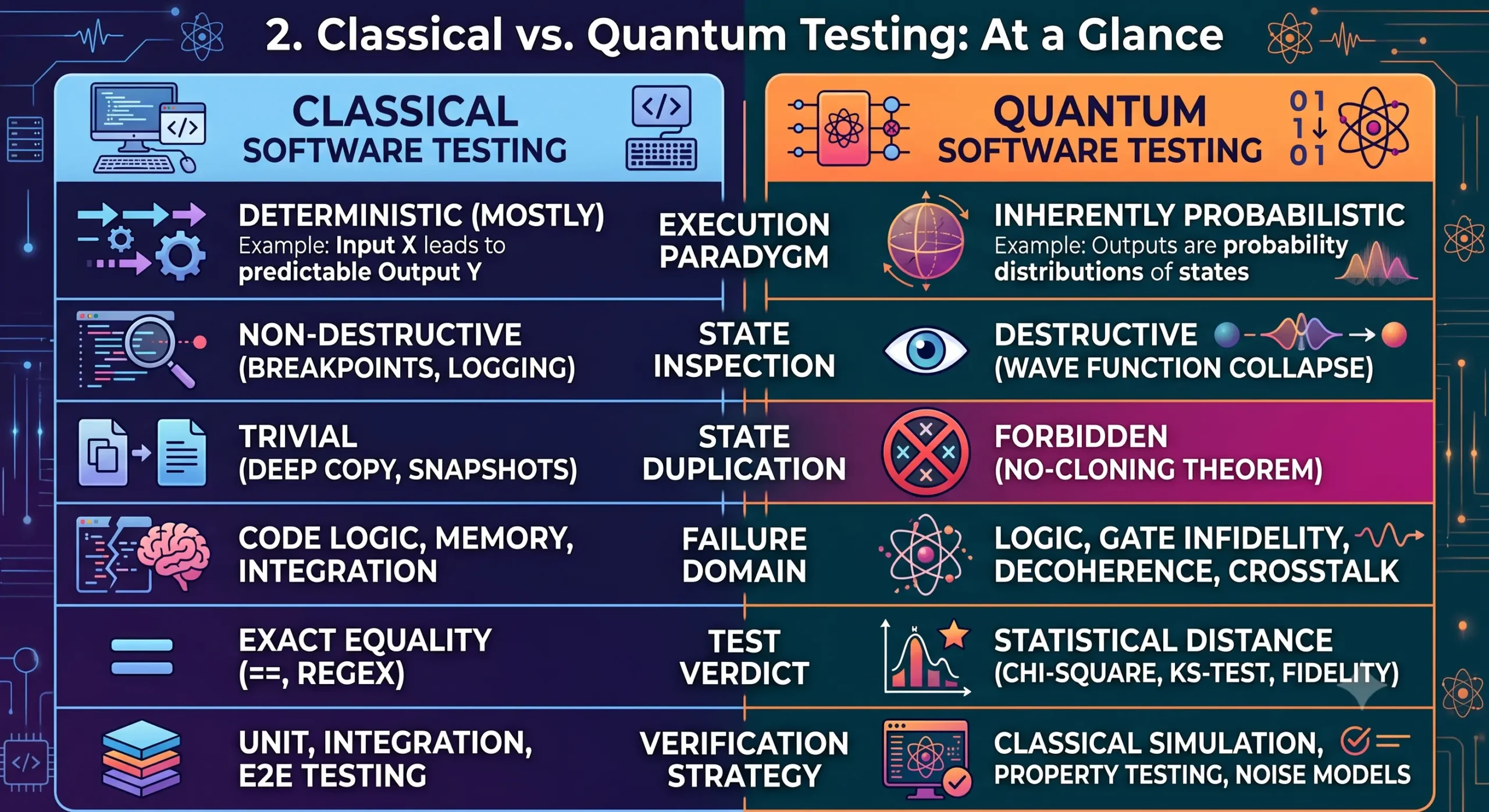
3. How Quantum Testing Actually Works
In order to work around these limitations, quantum test architectures make use of four core categories of verification and validation (V&V):Statistical & Sampling-Based AssertionsRather than running a circuit once to obtain an output, quantum testers run the circuit hundreds or thousands of times (“shots”), in order to produce an empirical output distribution which can be compared against theory; assertions check that the empirical distribution remains within statistical tolerance ($\epsilon$) of an ideal distribution, using TVD or quantum state fidelity as distance metrics.Classical Simulation & Statevector EmulationCircuits are often run on classical simulators prior to execution on actual Quantum Processing Units (QPUs). Statevector emulators maintain the entire statevector matrix at all times, allowing for full inspection of amplitudes, phases, and entanglement; while limited by an exponential scaling in the number of qubits (practical up to ~50), these are nonetheless standard for unit testing of small circuits.Metamorphic & Property-Based TestingWhen the classical expectation value of a quantum circuit’s output is unknown (the “oracle problem”), assertions are made instead about higher-level properties of the algorithm’s behavior through metamorphic testing:Circuit Inversion: Applying one’s circuit in reverse (taking advantage of the fact that any unitary $U^\dagger$ operator has an inverse $U$), and checking that the algorithm returns its input state $\vert{}0\dots0\rangle$ with near certainty.Symmetry Transformations: Applying transformations that preserve the identity of quantum states (e.g., permutations of gates or qubit phases) and checking that the algorithm’s output properties are unchanged.Noise Characterization and Error Mitigation TestingA quantum test suite needs to ensure that error mitigation routines (Zero-Noise Extrapolation, Probabilistic Error Cancellation, and Dynamical Decoupling techniques) are working as expected; QA engineers perform error mitigation tests in order to ensure that their algorithms achieve the expected suppression of noise, for a given noise model on a target QPU.
4. The Quantum DevOps (Q-DevOps) Pipeline
A mature quantum testing workflow is tightly woven into established CI/CD tooling but includes quantum-native stages:Linter & AST validation: Static code analysis of circuit depth, qubit layout, and gate synthesis rules before execution.Unit-level Emulation (mock backends): Fast statevector simulation in CI pipelines running on classical cloud runners.Noise-aware simulation: Execution of simulated circuits against hardware-specific noise profiles (calibration data, $T_1$/$T_2$ relaxation times).Hardware transpilation fidelity checks: Ensure that transpiler does not incur excessive SWAP-gate overhead when mapping virtual qubits to hardware topology.Execution & drift detection: Shots dispatched to production QPU backends with automated drift detection and statistical distribution validation against acceptable confidence thresholds.
The Path Forward
Testing at the quantum scale fundamentally redefines quality assurance as a process of statistical and physical characterization. The teams that best understand how to operate at the intersection of probabilistic assertions and noise aware pipelines, while building metamorphic validation into their software, will define the vanguard of reliable quantum computing.
What Software Testing Looks Like at the Quantum Scale
In classical software engineering, testing relies on a predictable bedrock: give an input, observe the state, assert the output. A failing test points directly to a deterministic logic bug.
At the quantum scale, that foundational rulebook breaks down. In quantum computing, intermediate states cannot be inspected without altering them, algorithms are inherently probabilistic, and the hardware itself operates under the influence of physical noise and decoherence.
Testing quantum software is not merely about adapting classical test suites—it requires rethinking verification, validation, and debugging from the physics up.