Most people hear the phrase ‘quantum computing’ and think only physicists in esoteric fields can understand it. They picture whiteboards covered in abstract math and labs surrounded by liquid helium.
The reality is that while making the actual hardware is difficult physics, programming it is simply a matter of writing down logic statements.
If you can write basic Python code and remember your high school math, you can absolutely learn this.
You don’t have to randomly guess by reading academic papers, either. Here is how you can go from total beginner to writing quantum circuits in a matter of months.
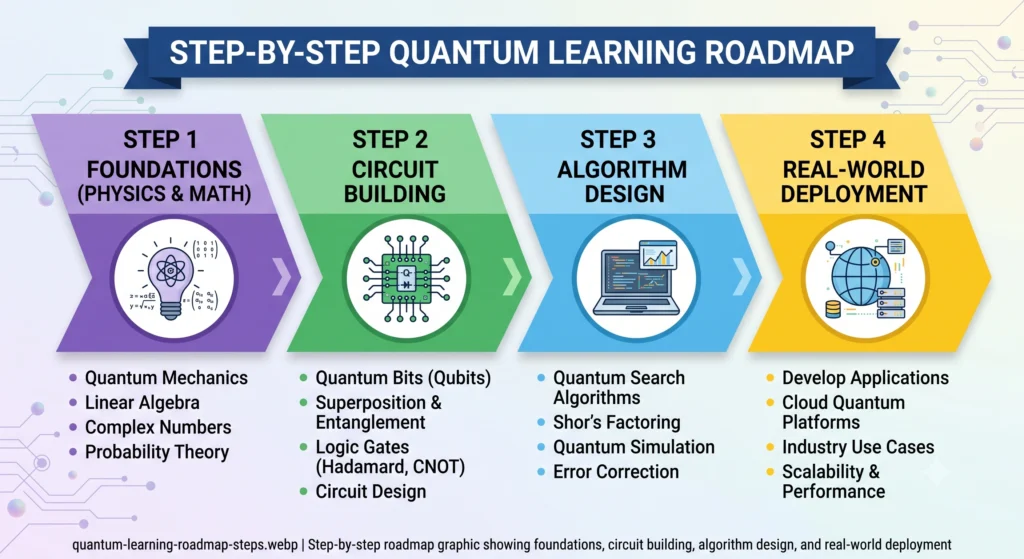
The 4-Step Quantum Learning Roadmap
Step 1: Learn Just Enough Math (And Skip the Rest)
Do not get bogged down by multi-variable calculus or university physics textbooks. When it comes to quantum programming, focus on these core mathematical concepts:
Vectors and Matrices: A qubit is represented as a vector, and quantum gates act as matrices. The matrix multiplies the qubit vector to change its values.
Complex Numbers: Unlike classical bits, a qubit has an extra attribute: a phase. Complex numbers are used to represent this phase.
Probability Theory: Measuring a qubit produces a probabilistic outcome rather than a fixed certainty. Basic probability helps you calculate these measurement outcomes.
If you know how to multiply two matrices together, you have enough math to proceed.
Step 2: Grasp the Three Big Principles
Every quantum program relies on three natural quantum behaviors:
Superposition: Like a coin spinning on a table, a qubit holds a blend of 0 and 1 until you decide to measure it.
Entanglement: When you connect two or more qubits together, changing one qubit instantly affects the others.
Interference: Good algorithms make incorrect answers cancel each other out—much like noise-canceling headphones—while boosting the correct answer so it is easy to read.
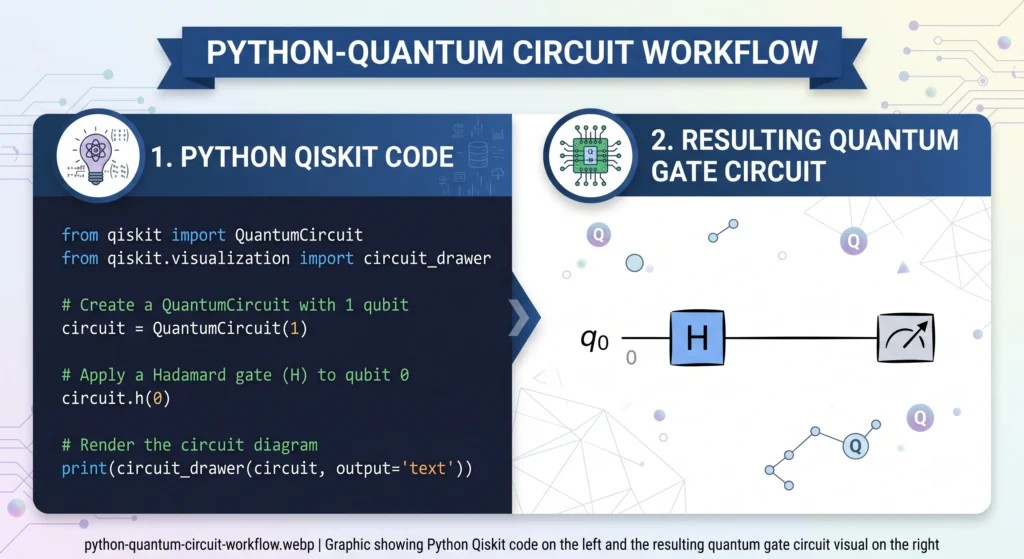
Step 3: Write Your First Circuits in Python
You don’t need access to an enterprise-grade server room to get started. Open-source libraries let you write and test quantum algorithms directly on your local machine:
Qiskit (IBM): The most established framework with the largest community, offering a familiar syntax for Python developers.
Cirq (Google): A framework built specifically for writing algorithms on near-term quantum processors.
PennyLane: The top choice for machine learning enthusiasts, integrating directly with PyTorch and TensorFlow.
Start small: demonstrate the entanglement of two qubits using the Bell state and run it on your local simulator.
Step 4: Run Code on Real Quantum Hardware
Simulators offer an effective environment for learning, but nothing replaces physical hardware.
Modern cloud platforms allow you to run your Python algorithms remotely on real quantum computers via an API key. You will observe realistic environmental noise in your calculations. You will also learn how to optimize gates to preserve circuit accuracy. This hands-on experience is what turns curious amateurs into paid professionals.
Take Your First Step Today
You don’t have to piece together old tutorials on your own. Our platform gives you interactive lessons, clear video walk-throughs, and browser-based coding labs.
Select your learning path, write your first quantum circuit, and start mastering the technology of tomorrow today!