For years quantum computing sounded like something that only happened in theory. It was an esoteric field, confined to physicists working in low temperature laboratories. Questions such as “when will a quantum computer finally be faster than a regular supercomputer” were common in the mainstream press.
Well, now we can stop wondering. Scientists and researchers have begun to see quantum advantage.
This is the point when a quantum system is able to perform a calculation that a classical supercomputer could not complete in the same time.
This change in our technological capabilities is not just another evolutionary step. We are witnessing a revolutionary change comparable to the invention of the microprocessor itself. Here are some of the reasons why quantum advantage is a big deal.
Quantum Computing Breaks the Limits of Classical Silicon Technology
For the past 5 decades engineers have been relying on the famous Moore’s law. It stated that the number of transistors on a chip can be doubled approximately every 2 years.
There was no fundamental reason why this should happen – engineers simply found ways to make silicon components smaller and more numerous.
Now we are approaching the limits of this capability. Moore’s law breaks down when the size of transistors approaches atomic scales, and issues such as heating and quantum tunneling begin to dominate.
Classical computers use bits to represent information. A bit always has a definite value – either 0 or 1. Even the most powerful supercomputers process information using linear operations – one step at a time.
Quantum computers, on the other hand, utilize fundamentally new methods of information processing.
Superposition – a quantum bit (qubit) can occupy multiple states simultaneously;
Entanglement – qubits can be linked in such a way that the state of one affects the state of another;
Interference – allows one to distinguish between different quantum states.
These principles allow one to build fundamentally new computing devices that can tackle problems inaccessible to regular supercomputers.
Solving Problems That Have No Solution
Quantum computers are not general purpose devices. They are not designed to run your everyday software. Engineers are building them to solve specific problems which regular supercomputers cannot handle.
Combinatorial explosions dominate many fields of science and engineering. The number of possibilities to be explored grows exponentially with the size of the problem. Even the most powerful supercomputers are unable to handle such situations.
Quantum advantage allows one to address several critical areas.
Molecular Modeling and Pharmacology
A quantum computer can simulate molecules by considering the quantum interactions between all electrons and nuclei. This capability is completely inaccessible to regular supercomputers because of memory limitations. Such simulations can revolutionize the drug discovery process. For example, clinical trials for new pharmaceutical substances can be reduced from 10 years to just several months.
Materials Science and Energy Storage
Quantum simulations allow one to develop new materials with custom designed properties. This is especially important for battery technologies and superconductors. Traditional approaches in this area are extremely time consuming.
Quantum computing can fundamentally change the landscape in these fields.
Logistics and Transportation
Modern transportation networks are becoming more complex by the day. Airlines and shipping companies are constantly looking for ways to optimize their routes and reduce fuel consumption. A quantum computer can handle this challenge by considering all possibilities simultaneously.
New Cryptographic Tools Are Needed
The field of cryptography is at the frontier of the race for quantum advantage. The RSA algorithm allows one to securely exchange information using large prime numbers.
It has withstood all attacks from would-be hackers for decades. However, Peter Shor showed that a sufficiently large quantum computer can factor large numbers with ease.
As a result, cryptographers are now scrambling to develop new methods of encryption.
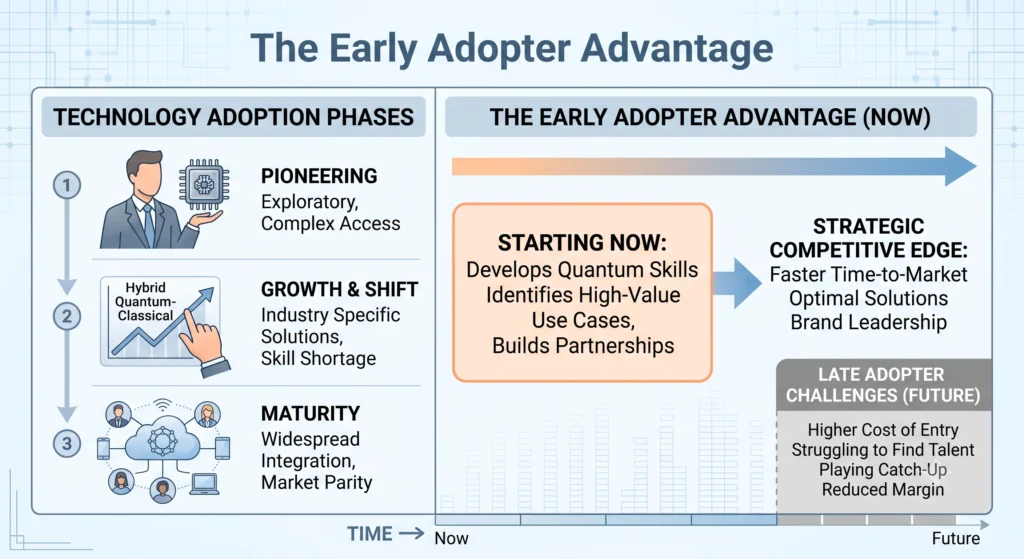
One should also note that forward-thinking companies are already preparing for this transition. One should not wait for a fully functional large-scale quantum computer to appear – everyone is encouraged to start now.
Early Adopters Receive Additional Rewards
The companies that jump into the new arena first will enjoy substantial benefits.
Pioneers gain access to a fast growing market,
Discover new applications for quantum hardware
and attract the best available talent.
As these firms build practical experience, other organizations will follow. The hybrid quantum-classical systems which can be built today will gradually penetrate all areas of the economy. Developers now use quantum programming languages such as Python. The major cloud providers offer quantum gate access to real quantum computers.
Some Final Thoughts
Quantum advantage and all related discoveries are no longer theoretical concepts. Researchers and companies are proceeding to actually build new quantum systems. This process is set to revolutionize modern pharmacology, cryptography, materials science and many other fields. Every company should think about how to benefit from this revolution. While hardware capabilities keep growing, the fundamental principles of quantum mechanics remain the same.